
So what does it actually take to prepare for offshore and blue water sailing?
In my mind, there are two paths—and both of them can work. One may be more efficient than the other, but they’re both valid.
Let’s start with the first path.
Path One: The Long Way
The first path is the one that a lot of people take—and the one I took myself.
It usually begins with some basic sailing instruction. Maybe a beginner course, and then something a little more intermediate—like an ASA 104 class. That gets people started.
From there, many people begin gaining experience on their own.
In my case, I started buying boats—smaller ones at first—and over time moved into larger vessels. I owned a number of sailboats over the years, and that became my classroom.
What followed was a long period of self-teaching.
I had to learn how to maintain, repair, install, and upgrade systems on my own, because there were no advanced courses available to take. I had heard about them, but I never actually saw them being offered anywhere.
That led me down a different path.
I ended up teaching myself a trade—becoming a shipwright, which means developing skills across multiple trades related to working on vessels.
Over time, I worked on thousands of boats. Diesel mechanic, electrical, plumbing, rigging—and alongside that, I was teaching sailing as well.
So everything beyond the basics had to be learned incrementally over time through experience.
And that process takes time.
In my case, it took 15 to 20 years to build the level of knowledge and skill required to safely operate offshore and eventually move into blue water cruising.
There are skill levels to accomplish offshore and blue water sailing that need to be achieved, but the education a real sailor is working toward is never actually finished.
To continue on that path, for me, it was a very long road.
It included ownership of multiple sailboats—about seven over time—starting with smaller vessels and working up.
It took thousands of hours of labor working on those boats. Learning systems. Fixing things. Installing equipment. Figuring things out the hard way.
It took hundreds and hundreds of sailing trips.
It took talking to other sailors, asking questions, and doing a lot of research.
And all of this took place before YouTube. In many cases, before the internet was even widely available. Even before GPS.
So the learning process was slow and steady.
It was built over a long period of time—through experience, repetition, and problem-solving.
Path Two: A More Efficient Way
Today, that slow path has been sped up quite a bit.
There’s a lot more information available now. People can self-teach, research online, watch videos, and learn from others in ways that simply didn’t exist before.
And that definitely helps.
But what we’re trying to do is offer a better path—one that’s far more efficient and helps you achieve your goals faster.
The path we offer doesn’t require owning multiple sailboats, outfitting them over time, or spending decades figuring things out on your own.
Instead, we get you immersed in offshore and blue water sailing right from the beginning.
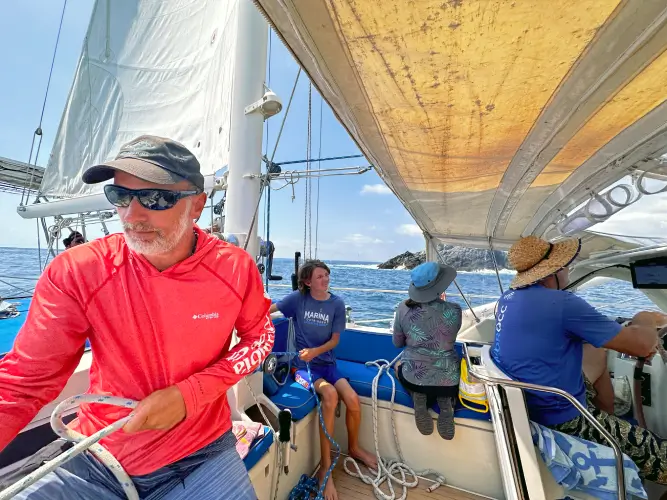
From day one, you’re stepping into the real environment.
In many cases, our trips start with a night passage. You’re immediately exposed to watchkeeping, navigation, and the rhythm of offshore sailing.
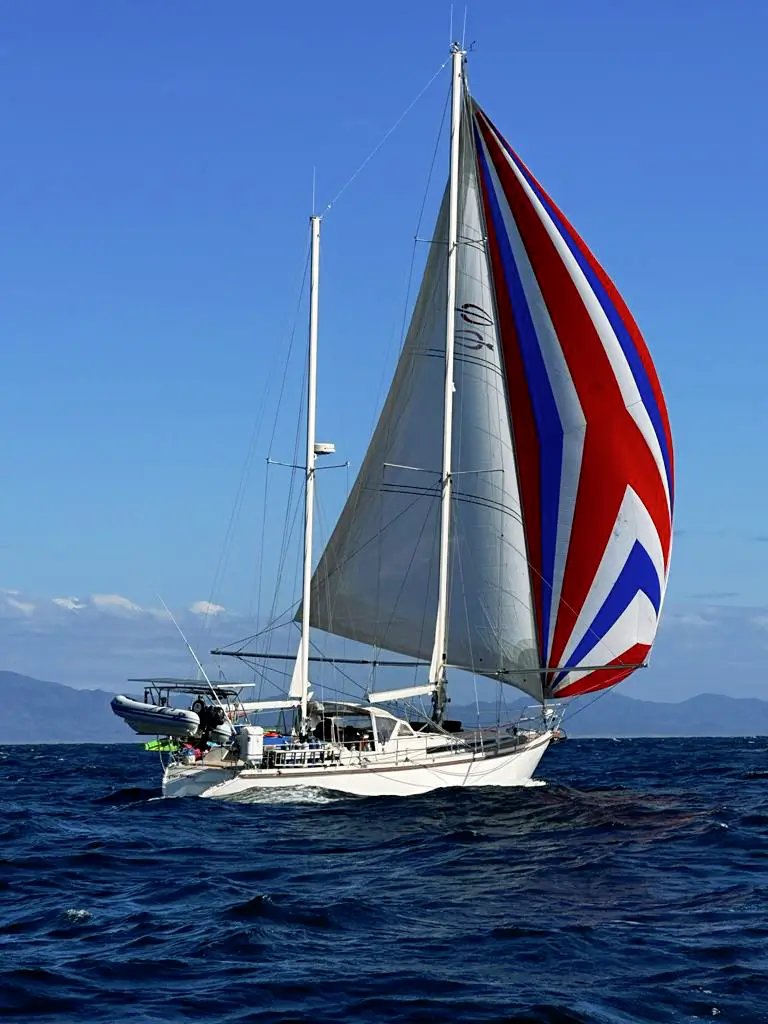
And all of this takes place on a true offshore, blue water cruising sailboat—the Amel Super Maramu 2000.
The Platform Matters
We’re also teaching on a boat that’s fully outfitted for real cruising—the Amel Super Maramu 2000.
It’s equipped with lithium batteries, solar, a generator, and a watermaker. You’re learning how to manage power, water, and systems the way you would on a real offshore passage.
It’s set up for living aboard—multiple refrigerators and freezers, a dishwasher, a washing machine. Everything you’d expect on a serious cruising vessel.
We also handle the day-to-day realities. Cleaning the bottom, maintaining the boat, managing systems underway—this is all part of the experience.
From a sailing standpoint, the boat is fully equipped. Multiple downwind sails, sail configurations for every point of sail and a wide range of wind conditions.
And of course, it’s outfitted with the full range of offshore safety equipment.
Learning in the Real Environment
In addition to that, our passages take you to incredible locations that require you to use the boat the way it’s actually meant to be used.
Channel Islands National Park, Catalina Island, offshore Baja California, the Sea of Cortez, and the tropical waters of mainland Mexico are all perfect examples of places that require every feature of a blue water vessel—living aboard and fully immersed in the skills needed to cruise those areas using this type of equipment.
You’re not just learning in theory—you’re actively using every system and applying the techniques required for offshore and blue water sailing.
That’s the difference.
You’re learning the skills and techniques in the environment where they actually matter—you’re fully immersed.
You’re on the boat, actively doing it—without having to buy six or seven boats and spend 20 years learning.
Because of that, you can compress years of learning into a very short period of time. What might take a decade or more to figure out on your own can be learned quickly when you’re fully immersed in it.
And it doesn’t stop there.
We also support our students beyond the training.
We also offer our clients broker services as buyer’s agents—at no cost to you—so you can utilize our many years of experience and knowledge to help you find the right vessel, if ownership and cruising are your goals.
We’re not tied to selling a specific brand or pushing inventory. The goal is to help you find the right boat for your goals—not just any boat.
And along the way, we provide guidance and consulting to help you make the right decisions as you move forward.
Choosing Your Path
So you can take either path and still end up in the same place.
One of those paths is long. It took me years—decades, really. It cost a tremendous amount of time, money, and effort. I put my entire life into learning it the hard way.
And I’m grateful for that path.
I’m grateful for what I learned, and I believe it’s what makes me a better instructor.
But you don’t have to take that route.
It’s a long road, and it’s an expensive one.
What I’m offering is a way to shorten that path—and save a lot of money along the way.
To take everything I’ve learned over decades and share it with you as efficiently as possible—so you can move forward faster, with the right foundation—and with this shared knowledge, you will be better equipped to figure things out on your own.
The Mission
It’s possible that the path I took is the one I needed—to become the person I am today, with the knowledge I now have.
And I’m grateful for that.
But I also believe that many people can achieve their goals without taking such a long, arduous journey.
That’s why I’m here.
To help people realize their cruising dreams.
And if I can save them years of time, money, and effort along the way—while teaching them what I’ve learned through decades of experience—then I’ve accomplished my mission.
At One World Sailing Academy, we’re focused on sharing knowledge and helping people achieve their cruising goals.