

Advanced Sailing and Coastal Cruising
Advanced sailing and coastal cruising really emphasize the desire for education, skill development, seamanship, and technique. In many ways, it is actually a more active and complex style of sailing than offshore passagemaking or crossing oceans.
With offshore and blue water sailing, the emphasis often shifts toward watch standing, long-duration passages, weather routing, onboard systems management, and settling into the rhythm of life at sea. While offshore sailing absolutely requires skill and preparation, there are long stretches of time where the routines become more steady and repetitive.
Coastal and offshore sailing are actually very different experiences.
When you are coastal cruising, there is much more happening on a daily basis. You may be anchoring frequently, entering and exiting harbors, navigating tighter coastal areas, managing changing conditions close to shore, launching and using the dinghy, exploring anchorages, and adapting to constantly changing situations.
Students participating in our advanced sailing courses are exposed to multiple anchoring techniques, roll stabilizers, route planning, coastal navigation, weather analysis, onboard systems management, dinghy operations, and the many day-to-day skills that become part of successful cruising.
A major part of advanced sailing is sail trim and understanding how to properly balance and manage the vessel in changing conditions. Students work extensively with reefing techniques, downwind sailing techniques, sail combinations, wind velocities, wind angles, balancing the boat, and learning how different sail configurations affect comfort, performance, and safety.
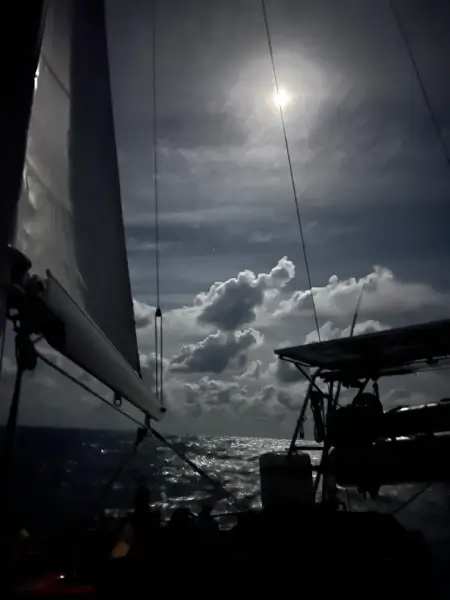
Students also fully learn how to utilize onboard electronics, radar, chart plotters, AIS, weather routing tools, forward-facing sonar, depth sounders, Starlink, and overall situational awareness while underway. We also have the pleasure of utilizing cruising guides whenever possible, which are an incredibly helpful tool that cruisers can use for passage planning, anchorages, local knowledge, and navigation information.
Another important part of coastal cruising is dealing with increased vessel traffic and coastal hazards. There are often significantly more boats operating close to shore, along with commercial traffic, fishing activity, fishing gear, changing weather patterns, and challenging coastal areas.
Coastal fog can become a major factor in some regions, particularly along the California coast, where weather can change dramatically due to coastal topography, and visibility can quickly become a challenge. Learning how to adapt to those changing conditions is an important part of both advanced navigation courses and successful coastal and offshore sailing.
There is also a deep dive into onboard systems and vessel maintenance because during coastal cruising you are actively using almost every system aboard the vessel. Students learn about electrical systems, charging systems, water systems, anchoring systems, onboard troubleshooting, and the daily routines required to keep a cruising boat operating properly.
When you are closer to shore and actively engaged in coastal cruising, that is often when major maintenance, repairs, provisioning, and vessel preparation take place. These are the opportunities sailors use to prepare vessels for longer offshore passages, advanced blue water sailing, or even ocean crossings.
There are also many logistical challenges involved with cruising from place to place. Students are exposed to customs procedures, checking in and out of countries and ports, provisioning logistics, language barriers, trip planning, fuel management, and the many real-world challenges that become part of long-distance cruising.
The dinghy also becomes a major part of the learning process. Students participate in dinghy operations, beach landings, anchoring the dinghy, going ashore, and learning how to safely enter and exit the water from both the vessel and the dinghy while swimming or snorkeling.
Over time, cruisers even begin learning the small practical details that become part of the lifestyle. Things like what footwear works best while landing a dinghy on shore, what type of hat to bring, sunscreen, water bottles, beach gear, whether to bring a chair, an umbrella, a book, or even a Frisbee for time ashore. It may sound minor, but these are all part of becoming comfortable and experienced with the cruising lifestyle.
Provisioning also becomes an important skill during extended coastal cruising. Students begin understanding how to manage food, water, fuel, supplies, and onboard storage while preparing for longer trips and changing conditions along the route.
Safety is another major part of the training. Students are exposed to onboard safety procedures, situational awareness, rough weather preparation, nighttime operations, navigation safety, and the importance of making smart decisions while operating in changing coastal environments. It is important to remember that coastal cruising often presents far more opportunities for hazards than an ocean crossing, simply because there are more vessels, navigational obstacles, changing conditions, fishing activity, and coastal challenges concentrated near shore.
Students also learn important anti-theft techniques and vessel security considerations, including how to protect the vessel, dinghy, outboard, and onboard equipment while traveling and anchoring in different locations.
Anchoring itself becomes a major area of instruction during advanced sailing courses. Students learn anchor watch procedures, anchor alarms, anchoring in different seabeds, bow and stern anchoring techniques, storm anchoring techniques, inclement weather anchoring techniques, and how to properly evaluate anchorages based on weather, swell direction, holding conditions, and changing environments.
In many ways, coastal cruising becomes a highly active learning environment because there are simply more variables involved. You are constantly making decisions, adjusting plans, evaluating anchorages, studying weather, managing the vessel, and operating in changing environments.
Because of that, advanced sailing and coastal cruising often become one of the best foundations for sailors who eventually want to transition into offshore passagemaking or advanced blue water sailing.
Once sailors become comfortable managing anchorages, systems, navigation, weather, vessel handling, and the daily routines involved with coastal cruising, the transition into offshore sailing often becomes much easier. The core seamanship and decision-making skills are already being developed on a daily basis.
At One World Sailing Academy, our immersive programs are designed around this style of learning. Students actively participate in the operation of the vessel while developing the skills required for both coastal cruising and offshore sailing.
Our advanced sailing courses are 100% hands-on participation because experience is the fastest teacher. Students are not simply reading about advanced sailing or watching YouTube channels. They are immersed in actual seamanship skills. They are actively anchoring, planning routes, managing systems, operating the dinghy, standing watches, adjusting sail plans, and learning how to operate a vessel safely and efficiently in a changing environment.
At One World Sailing Academy, our goal is to help students become capable, adaptable, and confident cruising sailors. Whether your long-term goals involve coastal exploration, offshore passagemaking, or eventually transitioning into advanced blue water sailing, the foundation begins with experience, repetition, and immersion aboard a properly equipped cruising vessel.