

Super Maramu
Amel Super Maramu 2000
One World Sailing Academy operates the Amel Super Maramu 2000, hull number 337, built in 2001, a CE Category A ocean-rated blue water cruising yacht designed for serious offshore and long-distance passagemaking or circumnavigation.
In 2000, the Amel Super Maramu 2000 was Cruising World’s Best Overall Cruising Boat of the Year, selected over 27 other boats. It was specifically designed as a long-distance offshore cruising yacht for sailors interested in circumnavigation or long-range, long-term sailing. Many Amel Super Maramu yachts have completed circumnavigations and are widely regarded as some of the best blue water cruising yachts ever built.
I will describe some of the features of the Amel Super Maramu 2000 and things that I like about the Amel Super Maramu 2000 in this article.
Hull Construction & Structural Integrity
First of all, let’s talk about the construction of the vessel. The fiberglass itself is proprietary to Amel, and the hull also utilizes a proprietary barrier-type coating designed to reduce or eliminate osmosis blistering. The entire hull is solid fiberglass, other than the deck. This makes it a highly capable offshore capable sailboat built for offshore conditions.
The vessel incorporates watertight collision bulkheads forward and aft, which are solid structural bulkheads. In addition, there are watertight internal bulkheads with sealable, gasketed doors. These bulkheads create five separate buoyant zones throughout the vessel, so in the event of damage or a breach in one area, the other zones remain isolated and do not flood. This structural division is a major contributor to its classification as a Category A ocean-rated sailboat, allowing the opportunity to potentially get the boat to an area where it could be hauled out and repaired, as opposed to it sinking.
A valve system is also integrated to prevent cross-flooding between compartments.
All bulkheads are fully fiberglassed into the structure, not simply glued in. The deck-to-hull joint is also fiberglassed together, as opposed to being glued and screwed like most production sailboats, creating a much stronger structure.
Ribs and stringers are also fully glassed into the hull structure rather than a glued-in structural grid found on most production boats, adding further structural integrity.
The deck is balsa-core construction, reducing weight while also improving insulation and comfort.
contact us
Through-Hull Philosophy & Watertight Design
The vessel is designed with a minimal number of through-hulls, which contributes to its overall offshore safety and reliability as an offshore capable sailboat.
A single sea chest system supplies all raw water intake for toilets, air conditioning, watermaker, engine, generator, and anchor washdown. This significantly reduces hull penetrations and improves safety. As you noted, the fewer through-hulls a vessel has, the less likely it is for leaks or failures to occur.
Discharge through-hulls such as sinks, shower sumps, and galley drains all feed into a centralized gray water bilge area located in the engine room, contained within watertight bulkheads.
Blackwater holding tanks are gravity-fed to shut-off valves mounted on fiberglass piping into the hull, without traditional through-hull fittings.
Cockpit drains are large structural fiberglass tubes that pass directly through the hull and do not require shut-off valves.
Overall, the vessel maintains a very limited number of through-hull penetrations, reducing the odds of failure and taking on water.
Keel, Rudder & Underwater Protection
The vessel features a wing keel with an Amel C-drive mounted on the aft side of the keel, protecting the drive system. This configuration also places the propeller deeper in the water, improving efficiency and reducing noise under power.
The vessel also features a skeg-hung rudder, which provides additional protection and strength for the steering system in offshore conditions.
There is also a retractable 10-horsepower bow thruster that provides strong maneuvering capability in low-speed, close-quartered maneuvering situations. The entire bow thruster is designed to be serviceable and removable while the vessel is in calm water, eliminating the need for a haulout.
Rig & Sailing Systems
The vessel also features a ketch rig, with both masts deck-stepped, eliminating deck penetrations through the upper structure that can potentially cause leaks. This makes it a true center cockpit cruising yacht designed for offshore safety and visibility.
The chain plates that support the shrouds holding up the masts are extremely strong and are integrated into the structure with dedicated lifting points on all four chain plates.
Speaking of the rig, the ketch rig also includes push-button electric furling systems for both the headsail and mainsail, along with electric primary winches for the jib sheets or spinnaker sheets, and an electric mainsheet winch as well, all operated via push-button controls. This makes it an easily manageable offshore sailing platform.
The mizzen sail is manually furled from inside the cockpit, which makes shorthanded sailing very manageable and efficient. Reefing is also straightforward and easy to execute, not requiring anybody to leave the safety of the center cockpit, which supports safe and controlled sail handling in offshore conditions.
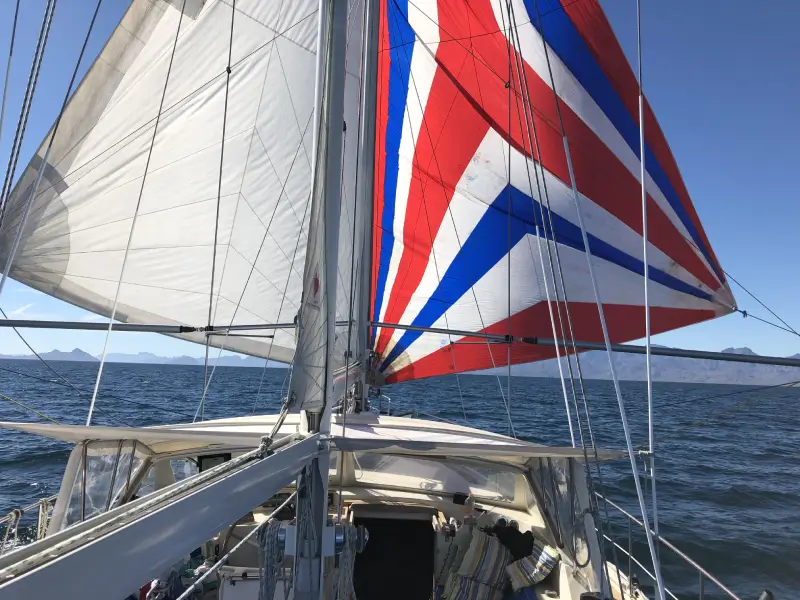
The furling system allows both headsail and ballooner to be managed together in accelerating wind conditions. This provides greater control and flexibility when transitioning between light air sailing and stronger gusts, allowing sail adjustments or reefing of the twin-pole sail setup to be done quickly and efficiently from the cockpit with no need to go on deck and douse a spinnaker.
This allows dual-sail downwind configurations.
Besides the main mast ballooner, the vessel also carries an asymmetrical spinnaker and two reaching spinnakers—one for the mainmast and one for the mizzen—allowing extensive sail area in light air and different configurations for varying wind angles and velocities, covering the full spectrum of downwind and reaching conditions encountered during long-distance blue water cruising yachts operations.
Cockpit & Layout
The vessel also features a highly protected center cockpit with a hard dodger and a solid windshield structure. Above that is an enclosed top with windows that can be unzipped for visibility and standing room during close-quarters maneuvering and docking.
The cockpit itself is fitted with cushions, a large cockpit table, and comfortable seating, creating a practical and protected space underway. It even acts as an additional room at anchor and becomes the social center of the vessel, even underway.
Access to the engine room is also extremely straightforward, with a large cockpit entry door that lifts up, providing direct access to all major systems for easy maintenance and operation.
Engine Room Systems
The engine room contains a Yanmar main engine, Onan generator, water heater, shore power transformer, watermaker, and battery charging systems that operate on either 220 volts or 24 volts. It also includes the fuel system with dual Racor filters, a freshwater pump system, an anchor wash pump, and the primary bilge pump for the entire vessel.
It is also equipped with intake and exhaust ventilation fans for safe airflow during engine operation.
Navigation & Electronics
The vessel also features Furuno radar, forward-looking sonar, B&G chart plotter, single sideband radio, AIS, EPIRB, two VHF radios, and multiple depth sounders.
The autopilot has dual drives: a linear drive on the rudder post and a chain drive at the helm, allowing easy switching between autopilot drives and therefore creating redundancy.
Deck & Safety Features
The vessel has a solid stainless steel top handrail providing secure handholds compared to wire lifelines.
The swim ladder doubles as a Mediterranean mooring ramp when mounted on the stern and backed up to a seawall.
A dive compressor, scuba tanks, and gear are onboard for hull cleaning and recreational diving.
The vessel was upgraded with a solar arch that also functions as a dinghy davit system and supports approximately 1,500 watts of solar power mounted on the arch, while also providing a secure system for carrying the dinghy.
On ocean crossings, the outboard engine may be removed from the dinghy and mounted on a dedicated rail mount for added safety and reduced load on the davits during offshore passages.
Integrated into the solar arch and dinghy davit system is a dedicated mount for an ocean-rated six-person life raft.
Power & Electrical Systems
The vessel has approximately 400 amp hours of 24-volt lithium battery capacity, supported by solar charge controllers.
A 4,000-watt inverter is installed, with additional inverter systems providing both 220V and 110V onboard power distribution.
Interior Systems & Comfort
The vessel includes a washing machine, dishwasher, microwave, propane stove, and multiple refrigeration/freezer units.
There are three air conditioning units that also provide heat, located in the aft cabin, main salon, and forward cabin.
The vessel has two heads, both with showers, and a cockpit shower.
Sleeping accommodations support up to seven people, with additional informal sleeping possible in the cockpit or aft sunpad. We have never had that many people on board, but it is possible.
Fuel & Range
The vessel carries 158 gallons of diesel, providing approximately 1,000 nautical miles of range under power at around 1,800 RPM and approximately 6.5 knots of boat speed in calm conditions. It can also carry 250 gallons of drinking water, but it is not necessary to do so since there is a watermaker onboard.
Offshore Cruising Reputation
The Amel Super Maramu 2000 was made widely known in the modern sailing world through the YouTube sailing channel SV Delos, who cruised around the world for approximately 10 years aboard the same make and model vessel, just one year older than the one we currently have. Their long-distance offshore cruising brought significant visibility to the Amel Super Maramu 2000 design and its capabilities as a true circumnavigating sailboat and catch-rigged sailboat platform.
Closing Philosophy
The Amel Super Maramu 2000 is designed for long-distance offshore cruising, redundancy, simplicity of operation, and safety. Its systems integration, structural integrity, and offshore capability make it a highly capable platform for extended blue water passages and circumnavigation-level cruising.
Since 2018, when I purchased this vessel, I have gone through almost every single system onboard, replacing or renewing components and conducting ongoing maintenance throughout the boat. The vessel has received all new sails, seven in total, as well as all new standing rigging, multiple running rigging upgrades, lithium batteries, and motor mounts, among many other improvements and refits.
In fact, One World has far exceeded all of my expectations, and it has taken me quite a while to get to know this boat really, really well. The more I understand the vessel—and I know it very well now—the more comfortable I feel cruising it. It is a fantastic boat and very worthy of the type of true advanced offshore instruction we are conducting on it. It is also fully capable of crossing oceans and taking you safely almost anywhere you want to go.